The file on
Alexander the Great
King of Macedon, 356-323 BC
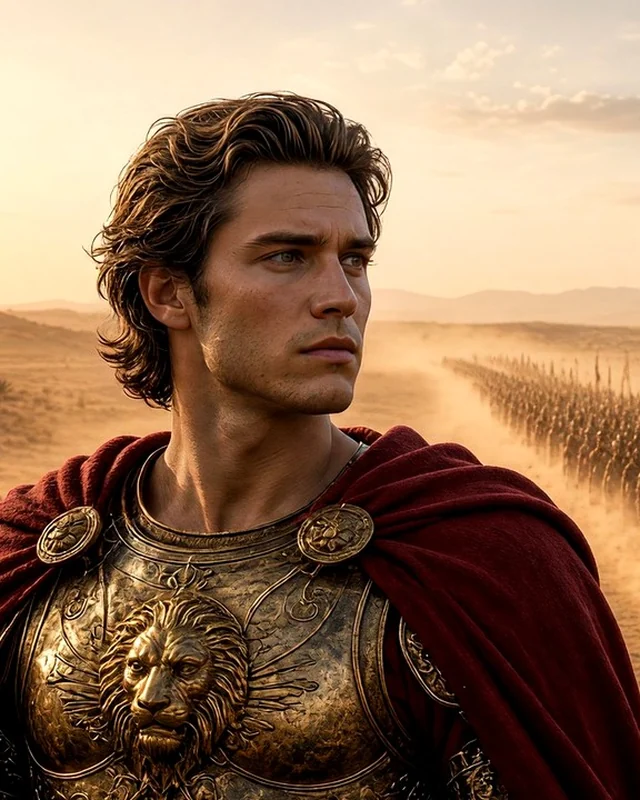
Alexander the Great, Alexander III of Macedon, became king at twenty, crossed into Asia, brought down the Persian Empire, and marched all the way to India before he died in Babylon at just thirty-two. In this hour-long episode of The Leader Files Podcast, Mike takes you through the whole life of the most famous conqueror of the ancient world, using the real words of the ancient historians Plutarch and Arrian, with honest notes on where the legends end and where the sources disagree.
We start in ancient Macedonia with King Philip II, the man who built the army Alexander inherited, and Queen Olympias, whose birth legends about thunderbolts, snakes and Zeus were already circulating in antiquity. You'll hear the true story of how a teenage prince tamed Bucephalas by turning him toward the sun, what Aristotle taught him at Mieza, and how Alexander helped win the Battle of Chaeronea. Then comes the wedding feast where a drunken Philip drew his sword on his own son, the assassination of Philip at Aigai, and the destruction of Thebes.
From there, the Persian campaign: the meeting with Diogenes at Corinth and what Diogenes really said, the visit to Troy and the tomb of Achilles, the Battle of the Granicus, the Gordian knot (and the two very different versions of it), the Battle of Issus against Darius III, and Alexander's treatment of the Persian royal family, including the queen mother Sisygambis. We cover the seven-month siege of Tyre, Gaza, Egypt, the founding of Alexandria, and the desert journey to the oracle of Ammon at Siwa.
Finally, Alexander's death in Babylon in three hundred twenty-three BC and the debate over its cause, the famous answer "to the strongest," the wars of his successors (Ptolemy, Seleucus, Antigonus and Cassander), and his legacy: the Hellenistic world, Koine Greek, Alexandria, Gandhara art, and Roman admirers like Pompey. We also hear the other side, from the Persian tradition that called him accursed to the cities that paid the price for his glory, plus the truth behind the "no more worlds to conquer" quote.
Along the way, Mike reacts, reflects and asks the big questions. Was Alexander a visionary who joined East and West, or a conqueror who left ruin behind him? Did he truly believe he was the son of Zeus? And why do Greeks, Persians, Egyptians and Indians still remember him so differently, more than two thousand years later? Every quote is clearly attributed to its source.
This is a balanced, family-friendly look at ancient history, ancient Greece and the Persian Empire, perfect for history lovers, students and anyone curious about the leaders who shaped our world.