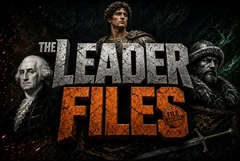
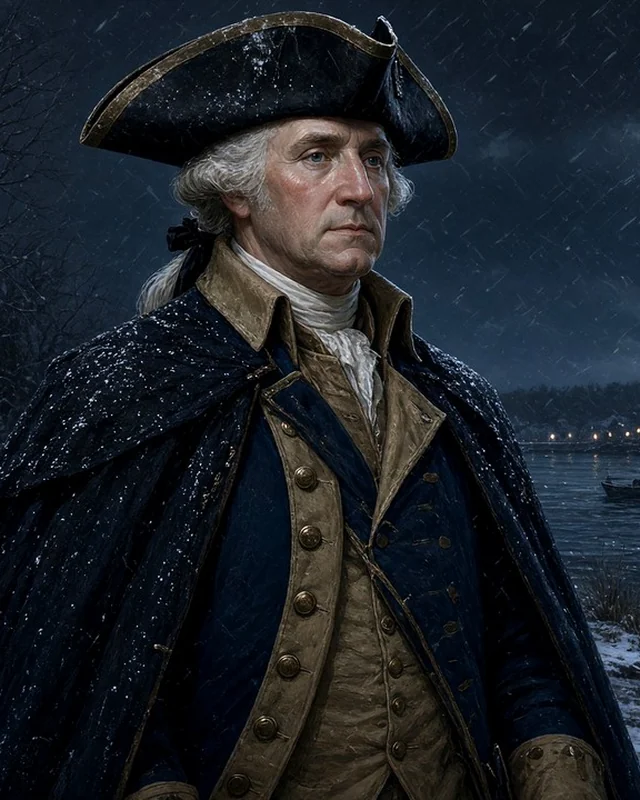
The file on
George Washington
First President of the United States, 1732-1799
He could have kept the army. He could have kept the presidency. Twice, George Washington handed power back, and that choice may be the most important thing any American leader has ever done. In this hour-long episode of The Leader Files Podcast, Mike tells the full life of George Washington, Founding Father, commander in chief of the Continental Army, and the first President of the United States. It's a conversational, honest deep dive into the American Revolution and the birth of the United States, covering the heroism, the mistakes, and the hard truths about slavery at Mount Vernon.
We start in colonial Virginia in 1732: the death of his father, his half brother Lawrence and the estate Lawrence named Mount Vernon, the 110 Rules of Civility he copied as a teenager, his work as a young surveyor, and the trip to Barbados where he survived smallpox. Then the French and Indian War: the disputed Jumonville affair, the surrender at Fort Necessity, and Braddock's defeat on the Monongahela, where, in his own words, he had four bullets through his coat and two horses shot under him.
Next comes his marriage to Martha Dandridge Custis, plantation life at Mount Vernon, his move from tobacco to wheat, and the slow road from loyal Virginia planter to revolutionary. In 1775 the Continental Congress makes him General and Commander in Chief, and he tells them he does not think himself equal to the command.
The Revolutionary War follows, battle by battle: the siege of Boston and Henry Knox's cannons on Dorchester Heights; the losses in New York and the escape across the East River in the fog; Thomas Paine's "times that try men's souls"; crossing the Delaware, the victory at Trenton and the gamble at Princeton; the hard winter at Valley Forge and the drillmaster Baron von Steuben; Lafayette and Alexander Hamilton; Benedict Arnold's treason at West Point; and the French alliance that trapped Cornwallis at Yorktown in 1781.
After the war, we cover the Newburgh crisis and the famous moment with his spectacles, his resignation in Annapolis in 1783 (and the story of what King George III supposedly said about it), and the Constitutional Convention. Then his presidency: the first inauguration, setting precedents for every president to come, the feud between Hamilton and Jefferson, the Whiskey Rebellion, the Jay Treaty, the Farewell Address warning against the spirit of party, and his decision to step down after two terms.
We finish with his death at Mount Vernon in 1799, Henry Lee's eulogy, "first in war, first in peace, and first in the hearts of his countrymen," and a plain look at slavery: the enslaved people he owned, Ona Judge's escape to freedom, and the will that freed the people he held in his own right. We also bust two myths, the cherry tree and the wooden teeth, and weigh his legacy fairly.